
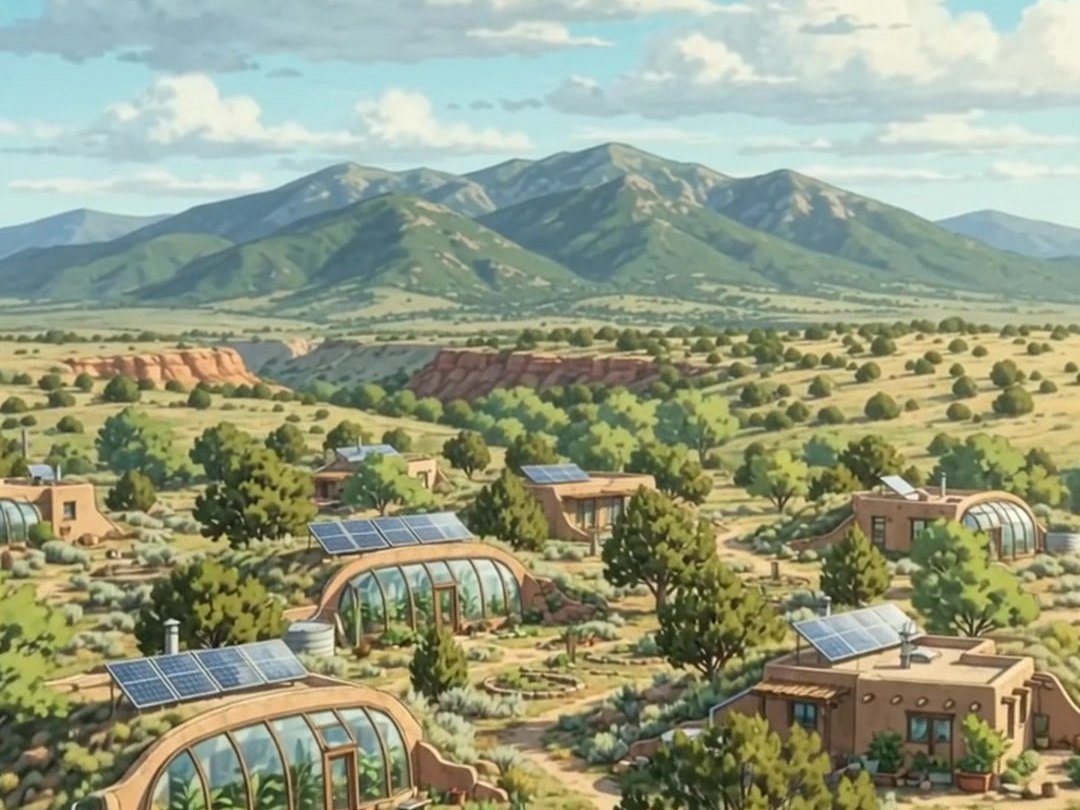
Short version: solarpunk is the idea of a future where technology and nature work together, with homes that run on the sun, catch their own water and grow food. It sounds like science fiction. It isn’t. Every rule below is already written into a law, a building code or a subdivision somewhere in the world. Put all five in one place and you have a solarpunk neighborhood. Pangea Community near Taos is designed around all five, and we think any new development could adopt them.
Rule 1: Power from the sun first
Every home makes its own power and stores it for the night.
Where it already works: since 2020, California has required solar panels on most new low-rise homes, sized to cover the home’s yearly electricity. New Mexico protects the right to use the sun: the Solar Rights Act of 1977 makes the use of solar energy a property right, and state law voids any covenant that effectively prohibits solar collectors.
How we do it: at Pangea Community, solar panels with battery storage are each home’s primary source of power. Grid power is only a backup, where it’s available and approved in Design Review.
Rule 2: Water from the sky, used twice
Catch the rain and snowmelt, then use every drop twice. The shower waters indoor plants, and the plants clean that water so it can flush the toilet.
Where it already works: Santa Fe County requires rainwater catchment on new homes. Since 2010, Tucson has required new single-family homes to be plumbed so greywater can be reused. New Mexico lets households reuse a modest amount of greywater for irrigation without a permit, within state rules.
How we do it: rainwater is the primary water supply at Pangea Community. Cisterns are sized by roof area and household, and greywater is reused for flushing and irrigation. On each homesite, more water is returned to the land through greywater reuse, irrigation and swale infiltration than the home draws. Try it with your own roof in our roof water calculator.
Rule 3: The house heats itself
Thick earth inside, insulation outside, and glass that faces the winter sun. The walls soak up the low sun all day and give the heat back at night.
Where it already works: towns protect the sun that makes this possible. In Boulder, Colorado, new buildings can only shade a neighbor’s lot so much, measured against an imaginary “solar fence” on the lot line. Ashland, Oregon, limits how tall a new building’s shadow can fall on the lot to its north.
How we do it: Pangea Community’s guidelines require mass-inside, insulation-outside walls and siting for passive solar. Homes can face any direction; each design is adjusted to its site so it still heats itself, and Design Review checks it.
Rule 4: Food at every home
Greenhouses, gardens and compost, so nothing leaves the loop.
Where it already works: cities already ask buildings to give green back to the land they cover. Singapore requires new developments to replace the greenery they build over, on roofs, terraces and walls. Toronto has required green roofs on large new buildings since 2009. France now requires plants or solar panels on the roofs of large new commercial buildings.
How we do it: greenhouse fronts grow greens inside the home through a Taos winter. Composting is required, planting is native and permaculture, and the community plans shared greenhouses, fields and a seed library. Read more on the Food and Farm page.
Rule 5: Build light, and count the carbon
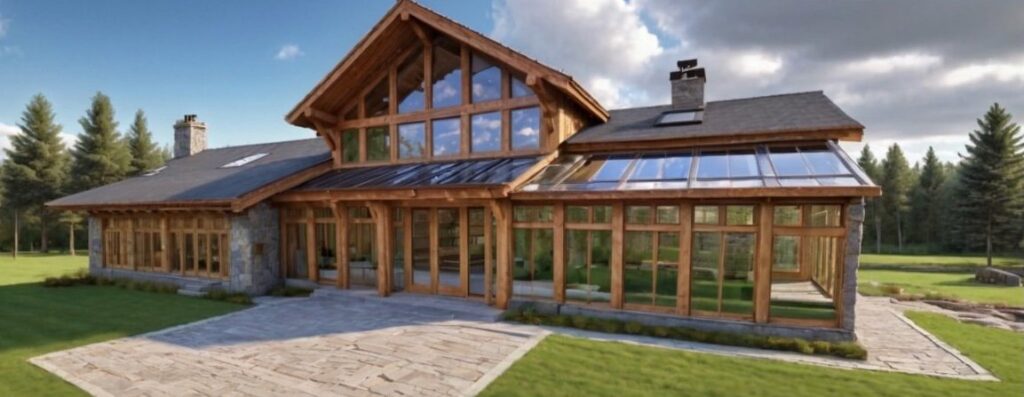
Local earth, reused materials, and an honest count of the carbon it takes to build.
Where it already works: in 2019, Marin County, California, adopted a building code that limits the carbon in concrete. Denmark has capped the lifetime carbon of large new buildings since 2023 and tightened the caps in 2025. France’s RE2020 rules cap the carbon of new homes and tighten over time.
How we do it: our guidelines favor local, recycled and durable materials, like earth, reused tires and local wood. Every carbon figure we publish includes embodied carbon, its payback and the lifetime net. Our solar calculator shows it for panels and batteries: a typical Taos household going off-grid needs about 9.1 kilowatts of panels, and the same household in a home that heats itself needs about 2.3, with roughly a quarter of the embodied carbon to pay back.
Put all five in one place
Each rule works on its own. Together they make a neighborhood that powers, waters, heats and feeds itself, built from materials that are light on the planet. That’s what solarpunk looks like on the ground.
We’d like to see more of it. If you’re an architect, builder, developer or county planner, the five rules, with where each one is already in force and how to write it into your own covenants or code, are on our standing page: Solarpunk development: five rules for builders and developers. We keep it up to date as new places adopt them.